How AI Fits Into B2B Marketing
(Without creating more chaos)Artificial Intelligence is everywhere right now.
Every tool promises faster campaigns, smarter targeting and better results.
Yet for many B2B founders and SME leaders, the reality feels a little different.
You hear about AI daily. Your LinkedIn feed is full of it. Someone in your network claims they have “fully automated marketing”. Meanwhile, your own marketing still needs direction and clarity.
And that is perfectly normal.
The truth is this.
AI in B2B marketing is powerful, but only when applied with structure and purpose.
Not hype.
Not panic buying software after watching one webinar.
Not producing 47 blog posts in a week because an AI tool made it possible.
This article explains where AI genuinely fits, where it does not, and how growing B2B companies can use it to create measurable value.
The Real Role of AI in B2B Marketing
AI is not a replacement for marketing leadership.
It is an accelerator, not a decision-maker.
For B2B companies, especially those between £250k and £3M turnover, marketing problems rarely come from a lack of tools.
They usually come from:
• Unclear strategy
• Poor prioritisation
• Weak messaging
• Fragmented execution
• Lack of senior marketing leadership
AI does not fix these issues on its own.
But when used properly, AI in B2B marketing can:
• Improve efficiency
• Enhance decision-making
• Support consistency
• Accelerate delivery
• Reduce wasted effort
Think of AI as a very capable assistant. Helpful, fast, and occasionally brilliant. But still in need of direction.
Left unsupervised, it will happily produce content about topics you never intended to write about.
Where AI Actually Adds Value in B2B Marketing
Many businesses jump into AI tools without knowing what problems they are solving.
That is usually where frustration begins.
Here is where AI genuinely creates value.
1.Market Research and Insight Generation
AI can dramatically speed up research processes.
Instead of manually reviewing endless reports or competitor websites, AI tools can help identify:
• Competitor positioning
• Market opportunities
• Customer sentiment
• Keyword patterns
• Industry language trends
For B2B companies operating in specialist markets, this can save days of work.
And more importantly, it helps leaders make better-informed decisions.
Which is far more useful than simply producing more content.
2. Content Creation and Messaging Support
This is where most businesses first encounter AI.
It is also where many misuse it.
AI can help generate:
• Blog outlines
• Article drafts
• LinkedIn content
• Email campaigns
• Landing page ideas
However, raw AI output is rarely ready to publish.
Without human oversight, content often becomes:
• Generic
• Repetitive
• Slightly robotic
• Occasionally confident but completely wrong
This is where an AI marketing strategist becomes valuable.
Their role is not to produce content faster. It is to ensure that content supports real business goals and reflects clear positioning.
Otherwise, you risk becoming extremely efficient at saying very little.
3. Campaign Optimisation and Performance Tracking
One of the strongest applications of AI in B2B marketing is performance analysis.
AI can help:
• Analyse campaign data quickly
• Identify patterns in customer behaviour
• Predict performance trends
• Recommend budget adjustments
• Highlight inefficiencies
For growing businesses, this provides something extremely valuable.
Visibility.
Not guesswork.
Not optimistic spreadsheets created late on a Friday afternoon.
Real insight.
4. Lead Qualification and Customer Journey Automation
AI is transforming how B2B businesses manage leads.
Used correctly, it can:
• Score leads automatically
• Identify high-intent prospects
• Trigger personalised messaging
• Support structured customer journeys
• Improve alignment between sales and marketing
For SaaS, fintech and IT service companies, this reduces friction across long sales cycles.
Which is particularly helpful when deals involve multiple decision-makers, technical reviews and more meetings than anyone expected at the start.
The Growing Demand for an AI Marketing Strategist
Tools are widely available.
Strategy is not.
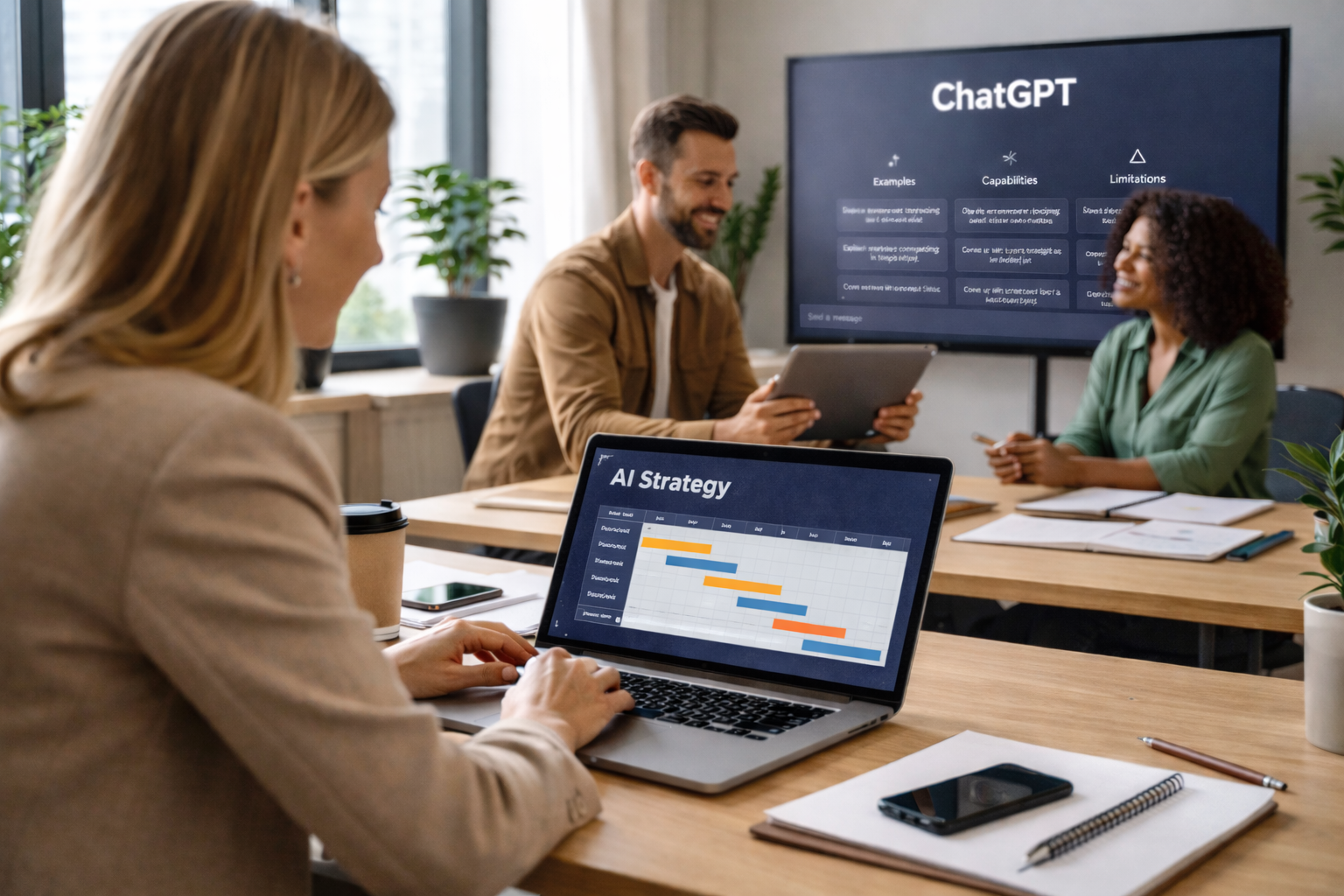
That is why the role of the AI marketing strategist is becoming more important.
Businesses do not just need someone who understands tools.
They need someone who understands:
• Where AI fits into the marketing structure
• What should be automated
• What should remain human-led
• How to integrate AI into workflows
• How to maintain brand clarity
Without this guidance, businesses risk:
• Tool overload
• Process confusion
• Fragmented messaging
• Marketing activity without direction
Technology without structure does not create growth.
It creates noise.
Often very busy-looking noise.
Understanding AI Marketing Services: What They Should Include
There has been a noticeable rise in companies offering AI marketing services.
Some are excellent.
Some are little more than traditional services with the word AI added to the front.
Effective AI marketing services should include:
• AI readiness assessment
• Marketing workflow mapping
• Tool selection guidance
• Prompt and process frameworks
• Content governance systems
• Performance measurement structures
This ensures AI becomes part of a structured marketing system rather than a collection of disconnected experiments.
The Biggest Mistake Companies Make With AI
Most B2B businesses adopt AI tactically.
Not strategically.
They start with:
• Content tools
• Automation software
• Chat-based systems
But skip:
• Strategy alignment
• Messaging clarity
• Process design
This creates a dangerous illusion.
More activity feels like progress.
But often produces:
More content
More emails
More dashboards
More confusion
Not more results.
AI should never be the starting point.
Strategy should be.
AI Marketing Trends B2B Companies Should Watch
AI adoption is accelerating, but not every trend deserves your attention.
Here are the AI marketing trends most relevant to growing B2B companies.
Trend 1: Workflow Automation, Not Just Content Creation
Content generation was the first visible shift.
But the real transformation is happening behind the scenes.
Expect to see more:
• Automated reporting
• Campaign orchestration
• Lead lifecycle automation
• Marketing operations efficiency
This reduces operational friction, which is one of the biggest hidden costs in B2B marketing.
Trend 2: AI-Assisted Decision Making
AI is increasingly used to support decision-making.
Not replace it.
Examples include:
• Channel prioritisation
• Budget allocation
• Performance forecasting
• Risk identification
Used correctly, this supports leadership decisions rather than replacing judgement.
And that distinction matters.
Trend 3: AI Augmented Marketing Teams
AI is reshaping how marketing teams operate.
Rather than replacing marketers, it enables smaller teams to achieve more.
Future teams will likely include:
• Fewer repetitive roles
• More strategic oversight
• Stronger technical awareness
• Greater operational efficiency
This is particularly important for SMEs that cannot justify large in-house teams.
AI provides capability without unnecessary headcount.
Where AI Does Not Replace Human Marketing Leadership
This is where clarity becomes critical.
AI cannot replace:
• Strategic thinking
• Market positioning
• Brand identity
• Value proposition design
• Leadership judgement
These require:
Experience
Context
Commercial awareness
AI enhances execution.
Leadership drives direction.
Without direction, even the best tools produce limited value.
How B2B SMEs Should Introduce AI Into Marketing
For companies between £250k and £3M turnover, AI adoption should be structured.
Not reactive.
A sensible approach includes:
Step 1
Assess current marketing maturity
Step 2
Identify operational bottlenecks
Step 3
Define priority improvements
Step 4
Introduce targeted AI tools
Step 5
Measure performance impact
This prevents disruption and protects marketing clarity.
It also reduces the temptation to sign up for five tools and forget why you bought them.
The Future of AI in B2B Marketing
AI will not replace marketing.
But it will redefine how marketing operates.
The businesses that benefit most will not be those using the largest number of tools.
They will be those using tools with purpose.
That means:
• Clear positioning
• Defined workflows
• Measured outcomes
• Leadership oversight
Not experimentation without structure.
Final Thoughts: AI Is a Capability, Not a Strategy
AI in B2B marketing is powerful.
But only when guided by experienced leadership.
Technology does not create growth.
Clarity does.
Structure does.
Strategy does.
AI simply accelerates what already works.
And very quickly exposes what does not.
FAQ's
How can AI improve B2B marketing performance?
AI can improve B2B marketing performance by analysing data more quickly, identifying patterns in customer behaviour and supporting better decision-making.
It can also automate repetitive tasks such as reporting, lead scoring and content preparation, allowing teams to focus on strategy and growth rather than administration.
However, results depend on how well AI tools are aligned with business objectives and marketing strategy.
Do small and medium-sized businesses really need AI in marketing?
Not every business needs AI immediately, but most growing B2B SMEs can benefit from introducing it gradually. Companies between £250k and £3M turnover often gain the most value from using AI to improve workflows, strengthen reporting and support consistent content delivery. The key is introducing AI with purpose rather than adopting tools simply because they are popular.
What does an AI marketing strategist do?
An AI marketing strategist helps businesses integrate artificial intelligence into their marketing in a structured and practical way. This includes identifying where AI adds value, selecting appropriate tools, creating repeatable workflows and ensuring that automation supports strategic goals. Rather than focusing purely on technology, an AI marketing strategist ensures that AI supports measurable business outcomes.
What are the most important AI marketing trends for B2B companies?
Some of the most important AI marketing trends for B2B companies include workflow automation, AI-assisted decision-making and improved lead qualification processes.
There is also growing adoption of AI-powered reporting tools and personalised customer journey automation.
These trends are helping businesses operate more efficiently without significantly increasing team size.
Can AI replace marketing teams or marketing leadership?
AI cannot replace marketing leadership or strategic thinking.
While it can support content creation, data analysis and automation, it still requires clear direction from experienced professionals who understand market positioning, customer behaviour and business goals.
AI enhances capability, but leadership determines success.
How should B2B SMEs start using AI in marketing?
The most effective way for B2B SMEs to start using AI is through a structured approach.
This usually involves assessing current marketing maturity, identifying inefficiencies and introducing targeted tools to address specific challenges.
Starting small and measuring results is usually more effective than implementing multiple tools at once.
Let's discuss your marketing
There is never a one size fits all solution to marketing as organisations need it in different ways depending on size, budget or requirement. The best thing to do is discuss your goals and we can work out from there where to go next.

matt@marketingpartnerto.co.uk

Marketing Partner To...
Matt Thomas
Based in Bournemouth, Dorset. Also available remotely or hybrid working in surrounding areas and London.